Showing posts with label rendering. Show all posts

Tuesday, May 16, 2017

Generating and Parsing Markup in Python [7]

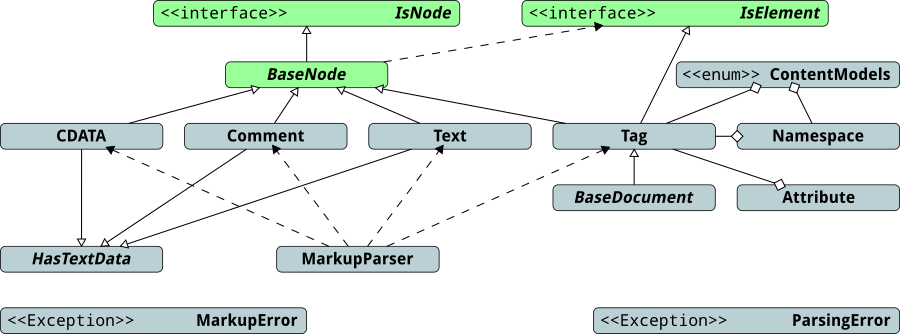
With the Tag class finally implemented (minus the couple of deferred items waiting on MarkupParser), it's time, I think, to work out the conventions for various types of markup documents. The approach that I plan on taking is to define a BaseDocument abstract class that derives from Tag in order to carry the capabilities of Tag through to all documents.

From that point on, it's just a matter of defining concrete document-classes for each of the document-types that I'm expecting to be using:
  • An HTML5Document;
  • An XHTMLDocument; and (probably)
  • An XMLDocument;
I'm not sure that this strategy would work across other languages with any frequency, though a quick check with PHP would seem to indicate that it would work. The following code, at any rate, doen't raise any errors when executed from the command-line:
<?php

abstract class BaseNode
{
}

class Tag extends BaseNode
{
}

abstract class BaseDocument extends Tag
{
}

class HTML5Document extends Tag
{
}

$doc = new HTML5Document();
?>

Before I can actually define those concrete document-classes, though, I need to determine what their members are, and how theier behavior differs from Tag...

What Are the Differences Between a Document and a Tag?

There are two main areas where documents differ from tag-elements: their object-members, and how they render. Since the three document-types that I'm concerned with have significantly different members (XML won't have head or body properties like an HTML document does, for example, and there are several other properties that fall into a similar classification), the list of members that need to be implemented is actually very short:

The all property
Basically just a call to Tag.getElementsByTagName( '*' ), returning all of the Tag children of the document;
The contentType property
Returns the MIME-type of the document
The doctype property
I haven't been able to pin down exactly what this does on the browser side, but it definitely relates to the <!DOCTYPE html> declaration in an HTML 5 document. My expectation as I'm writing this is that it will return the DOCTYPE for the instance as it would render.
While there are 200-odd more members in an HTML document, these are the only ones that I think might be relevant on the server side that aren't already going to be members of a BaseDocument just because it derives from Tag. A lot of the remainder were properties that have no meaning or use outside a broswer context (e.g., the readyState property and createEvent method, as well as all the on...* event-methods). Several of the properties are essentially just wrappers around some variation of Tag.getElementsByTagName for specific tags (images and scripts) or some similar mechanism with different criteria (links, possibly), and I'd probably not implement them (at last not in BaseDocument) even if they weren't document-type specific. I may well add those to specific concrete document-classes down the line, just so they're available, but they don't belong in BaseDocument.

On the rendering side, each of the document-types I'm planning to build out has slightly different output. Optional items are in brackets []:

HTML 5
<DOCTYPE html>
<html>
    <!-- the document head, body -->
</html>
XHTML
<!DOCTYPE html PUBLIC "-//W3C//DTD XHTML 1.0 Transitional//EN"
    "http://www.w3.org/TR/xhtml1/DTD/xhtml1-transitional.dtd">
<html[ xmlns="http://www.w3.org/1999/xhtml"]>
    <!-- the document head, body -->
</html>
(This is XHTML transitional, but there are also official strict and frameset variants, per the w3.org site)
Since it's technically XML, XHTML (of any flavor) can have processing-instructions and any other pre-document-root elements that XML allows.
XML
<?xml[ version="#.#"][ encoding="XXXX"]?>
[<?xml-processing-instruction(s) attributes="allowed"?>]
[<!DOCTYPE root-element[ PUBLIC "PUBLIC identifier"][ "SYSTEM identifier"]>]
<root-element[ attributes]>
    <!-- child elements and content -->
</root-element>
All of these, I think, can live in BaseDocument — the rules for them are of varying complexity, but they all feel like they're achievable at this level.

Looking at DOCTYPE

All three document-types have (or are allowed) some variation of a <!DOCTYPE>. The rules for a DOCTYPE declaration and how it gets rendered are pretty simple:

  • It starts with <!DOCTYPE
  • That's followed by the tagName of the root tag of the document
  • It may have a public identifier (a single-line text-value), in which case that should be rendered and prefixed with PUBLIC
  • It may also have a system identifier (also a single-line text-value):
    • If there is no public identifier, the system identifier should be rendered with SYSTEM as a prefix
    • Otherwise, it can just be rendered, with no prefix
  • It ends with >
  • It's the last thing rendered in output before the start of the Tag-derived structure and output
There are at least three different ways that a DOCTYPE representation could be implemented that I can think of.

The simplest way is, I think, to just store the applicable public and system identifiers as class-level constants, and render them accordingly in the __str__ and __unicode__ methods of the document-instance. That would work fine for HTML 5 and XHTML document-types, since the public and system identifiers for those document-types shouldn't ever change, really. That also has the advantage (I think) of keeping everything in one class-definition, so there'd be less code to manage. Unfortunately, that starts to fall apart as soon as XML documents enter the picture, unless a distinct document-class is built out for each and every XML document-type. That prospect feels ugly.

A more complicated approach is defining a class to represent a DOCTYPE. So long as an instance of that class has a reference to the document it's associated with, that'd allow it to grab the tagName that it needs at render-time. That would leave only the public- and system-identifier values to add to the __init__, so that they could be passed to the DOCTYPE-representative object during the construction of a document-instance. That doesn't feel horrible, but since it'd require additional arguments, with cryptic values, it feels clumsy. Even if those values were set up as module-level constants (which would help, I think), that's still more stuff that has to be remembered every time a document has to be created.

Still another possibility: A DOCTYPE for any given document-type is almost certainly as distinct as its namespace. If the public- and system-identifier values were attached to each Namespace instance, even if it were done outside the object-construction process, and a document's namespace were required during its construction, then the storage of those identifier-values is in a single place (a Namespace instance), and could be accessed in the __str__ and __unicode__ methods much like they could if they were class constants in the first alternative.

That feels pretty reasonable to me, but I think I'd also want to set up some sort of mechanism that would allow namespaces to be defined outside the actual Python code — possibly by setting one or many configuration-files that would define names and other relevant properties for any number of namespaces. The trade-off there is that any namespaces defined by that sort of configurable set-up probably couldn't be referred to as module-level constants — As things stand right now, I'd defined Namespace-instance constants in the markup module for HTML 5 and XHTML documents both:

# HTML 5 namespace
HTML5Namespace = Namespace(
    'html5',
    'http://www.w3.org/2015/html', 
    renderingModels.RequireEndTag,
    br=renderingModels.NoChildren,
    img=renderingModels.NoChildren,
    link=renderingModels.NoChildren,
    )
__all__.append( 'HTML5Namespace' )

# XHTML namespace
XHTMLNamespace = Namespace(
    'xhtml',
    'http://www.w3.org/1999/xhtml', 
    renderingModels.RequireEndTag,
    br=renderingModels.NoChildren,
    img=renderingModels.NoChildren,
    link=renderingModels.NoChildren,
    )
__all__.append( 'XHTMLNamespace' )
Those constants would, I think, have to go away in order to keep access to all available namespaces reasonably consistent.

Or, perhaps not, now that I think on it more. If each application that needs to have one or more namespaces defined actually defines them as constants within that application, then they are accessible as constants within that application's codebase. That might, down the line, require some movement of more general-purpose Namespace definitions into a common location — maybe in markup, maybe elsewhere — but they'd still be accessible the same way that HTML5Namespace and XHTMLNamespace are now.

With all of those options considered, I'm going to take this last approach, I think. It feels reasonable, keeps things relatively well-contained, and doesn't require a huge amount of refactoring of Namespace or a lot of additional code in BaseDocument. As it turns out, a similar approach/solution can be applied to the contentType of BaseDocument — referring to the document's namespace, which in turn has a ContentType property whose value is set during the construction of the instance. The complete changes to Namespace are:

#-----------------------------------#
# Instance property-getter methods  #
#-----------------------------------#

@describe.AttachDocumentation()
def _GetContentType( self ):
    """
Gets the MIME-type associated with documents of the namespace the instance 
represents"""
    return self._contentType

# ...

@describe.AttachDocumentation()
def _GetPublicIdentifier( self ):
    """
Gets the public identifier of the namespace."""
    return self._publicIdentifier

@describe.AttachDocumentation()
def _GetSystemIdentifier( self ):
    """
Gets the system identifier of the namespace."""
    return self._systemIdentifier

#-----------------------------------#
# Instance property-setter methods  #
#-----------------------------------#

@describe.AttachDocumentation()
@describe.argument( 'value', 
    'the MIME-Type to set for documents of the namespace the instance '
    'represents',
    str, unicode, None
)
@describe.raises( TypeError, 
    'if passed a value that is not a str, a unicode, or None'
)
@describe.raises( ValueError, 
    'if passed a value that is not a member of %s' % ( 
        sorted( KnownMIMETypes )
    )
)
def _SetContentType( self, value ):
    """
Sets the MIME-Type of the instance"""
    if value != None and type( value ) not in ( str, unicode ):
        raise TypeError( '%s.ContentType expects a str or unicode value '
            'that is one of the known MIME-types on the system, or None, '
            'but was passed "%s" (%s)' % ( 
                self.__class__.__name__, value, type( value ).__name__ )
            )
    if value not in KnownMIMETypes:
        raise ValueError( '%s.ContentType expects a str or unicode value '
            'that is one of the known MIME-types on the system, or None, '
            'but was passed "%s" which could not be found' % ( 
                self.__class__.__name__, value )
            )
    self._contentType = value

# ...

@describe.AttachDocumentation()
@describe.argument( 'value', 
    'the public identifier of the namespace to set for the instance',
    str, unicode
)
@describe.raises( TypeError, 
    'if passed a value that is not a str or unicode type or None'
)
@describe.raises( ValueError, 
    'if passed a value that has multiple lines in it'
)
def _SetPublicIdentifier( self, value ):
    """
Sets the public-identifier value for the instance"""
    if type( value ) not in ( str, unicode ) and value != None:
        raise TypeError( '%s.PublicIdentifier expects a single-line str '
            'or unicode value, or None, but was passed "%s" (%s)' % ( 
                self.__class__.__name__, value, type( value ).__name__ )
            )
    if value:
        if '\n' in value or '\r' in value:
            raise ValueError( '%s.PublicIdentifier expects a single-line '
                'str or unicode value, or None, but was passed "%s" (%s) '
                'which has multiple lines' % ( 
                    self.__class__.__name__, value, type( value ).__name__
                )
            )
    self._publicIdentifier = value

@describe.AttachDocumentation()
@describe.argument( 'value', 
    'the system identifier of the namespace to set for the instance',
    str, unicode
)
@describe.raises( TypeError, 
    'if passed a value that is not a str or unicode type or None'
)
@describe.raises( ValueError, 
    'if passed a value that has multiple lines in it'
)
def _SetSystemIdentifier( self, value ):
    """
Sets the System-identifier value for the instance"""
    if type( value ) not in ( str, unicode ) and value != None:
        raise TypeError( '%s.SystemIdentifier expects a single-line str '
            'or unicode value, or None, but was passed "%s" (%s)' % ( 
                self.__class__.__name__, value, type( value ).__name__ )
            )
    if value:
        if '\n' in value or '\r' in value:
            raise ValueError( '%s.SystemIdentifier expects a single-line '
                'str or unicode value, or None, but was passed "%s" (%s) '
                'which has multiple lines' % ( 
                    self.__class__.__name__, value, type( value ).__name__ )
                )
    self._systemIdentifier = value

#-----------------------------------#
# Instance property-deleter methods #
#-----------------------------------#

@describe.AttachDocumentation()
def _DelContentType( self ):
    """
"Deletes" the MIME-type associated with documents of the namespace the instance 
represents by setting it to None"""
    self._contentType = None

# ...

@describe.AttachDocumentation()
def _DelPublicIdentifier( self ):
    """
"Deletes" the public identifier of the namespace by setting it to None."""
    self._publicIdentifier = None

@describe.AttachDocumentation()
def _DelSystemIdentifier( self ):
    """
"Deletes" the system identifier of the namespace by setting it to None."""
    self._systemIdentifier = None

#-----------------------------------#
# Instance Properties               #
#-----------------------------------#

ContentType = describe.makeProperty(
    _GetContentType, None, None, 
    'the MIME-type of the content expected for a document of the '
    'namespace the instance represents',
    str, unicode, None
)

# ...

PublicIdentifier = describe.makeProperty(
    _GetPublicIdentifier, None, None, 
    'the public identifier of the namespace',
    str, unicode, None
)
SystemIdentifier = describe.makeProperty(
    _GetSystemIdentifier, None, None, 
    'the system identifier of the namespace',
    str, unicode, None
)

#-----------------------------------#
# Instance Initializer              #
#-----------------------------------#
@describe.AttachDocumentation()

# ...

@describe.argument( 'contentType', 
    'the MIME-type of the content associate with the instance',
    str, unicode, None
)
    @describe.argument( 'publicId', 
        'the public-identifier of the namespace',
        str, unicode, None
    )
@describe.argument( 'systemId', 
    'the system-identifier of the namespace',
    str, unicode, None
)

# ...

def __init__( self, name, namespaceURI, contentType, systemId=None, 
    publicId=None, defaultRenderingModel=renderingModels.Mixed, 
    **tagRenderingModels ):
    """
Instance initializer"""

    # ...

    # Set default instance property-values with _Del... methods as needed.
    self._DelContentType()

    # ...

    self._DelPublicIdentifier()
    self._DelSystemIdentifier()
    # Set instance property values from arguments if applicable.
    self._SetContentType( contentType )

    # ...

    self._SetPublicIdentifier( publicId )
    self._SetSystemIdentifier( systemId )
The HTML5Namespace- and XHTMLNamespace-constants change slightly, to:
#-----------------------------------#
# Default Namespace constants       #
# provided by the module.           #
#-----------------------------------#

# HTML 5 namespace
HTML5Namespace = Namespace(
    'html5',
    'http://www.w3.org/2015/html', 
    'text/html',
    None,
    None,
    renderingModels.RequireEndTag,
    br=renderingModels.NoChildren,
    img=renderingModels.NoChildren,
    link=renderingModels.NoChildren,
    )
__all__.append( 'HTML5Namespace' )

# XHTML namespace
XHTMLNamespace = Namespace(
    'xhtml',
    'http://www.w3.org/1999/xhtml', 
    'text/html',
    'http://www.w3.org/TR/xhtml1/DTD/xhtml1-transitional.dtd',
    '-//W3C//DTD XHTML 1.0 Transitional//EN',
    renderingModels.RequireEndTag,
    br=renderingModels.NoChildren,
    img=renderingModels.NoChildren,
    link=renderingModels.NoChildren,
    )
__all__.append( 'XHTMLNamespace' )
Finally, unit-tests get updated and run:
########################################
Unit-test results
########################################
Tests were successful ..... False
Number of tests run ....... 265
 + Tests ran in ........... 0.17 seconds
Number of errors .......... 0
Number of failures ........ 1
Number of tests skipped ... 107
########################################
FAILURES
#--------------------------------------#
testCodeCoverage (__main__.testmarkupCodeCoverage)
AssertionError: 
    Unit-testing policies require test-cases for all classes 
    and functions in the idic.markup module, but the following 
    have not been defined:
        (testBaseDocument)
And that, I believe, provides everything needed to implement the doctype property in BaseDocument, which could then also be used in its __str__ and __unicode__ methods to render it if/as needed.

Looking at the XML Headers

Apart from their final output, both the initial XML declaration and any XML processing-instruction that I've run across look, structurally, like they could be represented by a Tag-variant: They have a name, and can have attributes. That does not include any inline DTD specifications (see the An Internal DTD Declaration section here for an example of this), but I don't honestly expect that providing an inline DTD is something that will be needed, so I'm not going to worry too much about that, at least for the time being.

As a result, my first thought with regards to implementing those is to generate a Tag subclass, possibly as an inline/nested class in BaseDocument itself, that overrides the __str__ and __unicode__ methods to generate the right output. That would then allow a document-level property (call it XMLDeclaration) to provide the initial XML declaration, and a collection of those tag-types (XMLProcessingInstructions, as an ElementList) to represent any of the XML processing-instructions for a document-instance. That implementation looks like this:


@describe.InitClass()
class BaseDocument( Tag, object ):

    # ...

    #-----------------------------------#
    # Inline class definitions          #
    #-----------------------------------#

    @describe.InitClass()
    class XMLTag( Tag, object ):

        # ...

        #-----------------------------------#
        # Instance Initializer              #
        #-----------------------------------#
        @describe.AttachDocumentation()
        @describe.argument( 'tagName',
            'the tag-name to set in this created instance',
            str, unicode
        )
        @describe.keywordargs( 
            'the attribute names/values to set in the created instance'
        )
        def __init__( self, tagName, **attributes ):
            """
Instance initializer"""
            Tag.__init__( self, tagName, **attributes )

        # ...

        #-----------------------------------#
        # Instance Methods                  #
        #-----------------------------------#

        @describe.AttachDocumentation()
        def __str__( self ):
            """
Returns a string representation of the instance"""
            try:
                result = '<?%s' % ( self.tagName )
                for name in self.attributes:
                    result += ' %s="%s"' % ( name, self.attributes[ name ] )
                result += '?>'
                return result
            except ( UnicodeDecodeError, UnicodeEncodeError, UnicodeError ):
                return __unicode__( self )

        @describe.AttachDocumentation()
        def __unicode__( self ):
            """
Returns a unicode representation of the instance"""
            result = u'<?%s' % ( self.tagName )
            for name in self.attributes:
                result += u' %s="%s"' % ( name, self.attributes[ name ] )
            result += u'?>'
            return result

        # ...

    #-----------------------------------#
    # Class attributes (and instance-   #
    # attribute default values)         #
    #-----------------------------------#

    # ...
With that class available, the two BaseDocument properties noted above can be implemented, making them available for use in the rendering processes of BaseDocument.__str__, and BaseDocument.__unicode__. Some helper-methods defined in BaseDocument, to set or add items to those properties, will also need to be created, but they feel pretty simple:
SetXMLVersion( version ):
Sets the "version" attribute of the instance's XMLDeclaration, creating it in the process if necessary
SetXMLEncoding( encoding ):
Sets the "encoding" attribute of the instance's XMLDeclaration, creating it in the process if necessary
CreateXMLInstruction( name, **attributes ):
Creates and adds an XML processing-instruction to the instance's XMLProcessingInstructions collection

The Final Implementation of BaseDocument

There's not a whole lot present in BaseDocument, but there are some significant chunks over and above the properties noted earlier. The implementation of the __init__ methodof BaseDocument and the three XML-structure-related methods are pretty simple:

#-----------------------------------#
# Instance Initializer              #
#-----------------------------------#
@describe.AttachDocumentation()
@describe.argument( 'tagName',
    'the tag-name to set in this created instance',
    str, unicode
)
@describe.argument( 'namespace',
    'the namespace that the instance belongs to',
    Namespace
)
@describe.keywordargs( 
    'the attribute names/values to set in the created instance'
)
def __init__( self, tagName, namespace, **attributes ):
    """
Instance initializer"""
    # BaseDocument is intended to be an abstract class,
    # and is NOT intended to be instantiated. Alter at your own risk!
    if self.__class__ == BaseDocument:
        raise NotImplementedError( 'BaseDocument is '
            'intended to be an abstract class, NOT to be instantiated.' )
    # Call parent initializers, if applicable.
    Tag.__init__( self, tagName, namespace, **attributes )
    # Set default instance property-values with _Del... methods as needed.
    self._DelXMLDeclaration()
    self._DelXMLProcessingInstructions()
    # Set instance property values from arguments if applicable.
    # Other set-up

#-----------------------------------#
# Instance Garbage Collection       #
#-----------------------------------#

#-----------------------------------#
# Instance Methods                  #
#-----------------------------------#

@describe.AttachDocumentation()
@describe.argument( 'tagName',
    'the tag-name to set in this created instance',
    str, unicode
)
@describe.keywordargs( 
    'the attribute names/values to set in the created instance'
)
def CreateXMLInstruction( self, tagName, **attributes ):
    """
Creates an XMLTag instance with the supplied tag-name and attributes and appends 
it to the instance's XML processing-instructions"""
    if not self.XMLDeclaration:
        self._SetXMLDeclaration( BaseDocument.XMLTag( 'xml' ) )
    self.XMLProcessingInstructions.append( 
        BaseDocument.XMLTag( tagName, **attributes )
    )

@describe.AttachDocumentation()
@describe.argument( 'value', 
    'the encoding value to set in the instance\'s xml declaration', 
    str, unicode
)
@describe.raises( TypeError, 
    'if passed an encoding value that is not a str or unicode'
)
@describe.raises( ValueError, 
    'if passed an encoding value that is not a single word'
)
def SetXMLEncoding( self, value ):
    """
Sets the "encoding" attribute-value in the instance's XMLDeclaration"""
    if type( value ) not in ( str, unicode ):
        raise TypeError( '%s.SetXMLEncoding expects a single-word str or '
            'unicode value for its encoding, but was passed "%s" (%s)' % ( 
                self.__class__.__name__, value, type( value ).__name__ )
            )
    if ' ' in value or '\n' in value or '\t' in value or '\r' in value:
        raise ValueError( '%s.SetXMLEncoding expects a single-word str or '
            'unicode value for its encoding, but was passed "%s" which is '
            'invalid' % ( self.__class__.__name__, value )
        )
    if not self.XMLDeclaration:
        self._SetXMLDeclaration( BaseDocument.XMLTag( 'xml' ) )
    self.XMLDeclaration.setAttribute( 'encoding', value )

@describe.AttachDocumentation()
@describe.argument( 'value', 
    'the version value to set in the instance\'s xml declaration', 
    str, unicode, float, int, long
)
@describe.raises( ValueError, 
    'if passed a version value that is not a float and cannot be converted '
    'to one'
)
def SetXMLVersion( self, value ):
    """
Sets the "version" attribute-value in the instance's XMLDeclaration"""
    if type( value ) != float:
        try:
            checkValue = float( value )
            if checkValue < 1.0:
                raise ValueError
            value = str( checkValue )
        except:
            raise ValueError( '%s.SetXMLVersion expects a float value '
                'greater than or equal to one, or a text or numeric value '
                'that can be converted to one, but was passed '
                '"%s" (%s)' % ( 
                    self.__class__.__name__, value, type( value ).__name__ )
                )
    else:
        if value < 1.0:
            raise ValueError( '%s.SetXMLVersion expects a float value '
                'greater than or equal to one, or a text or numeric value '
                'that can be converted to one, but was passed '
                '"%s" (%s)' % ( 
                    self.__class__.__name__, value, type( value ).__name__ )
                )
    if not self.XMLDeclaration:
        self._SetXMLDeclaration( BaseDocument.XMLTag( 'xml' ) )
    self.XMLDeclaration.setAttribute( 'version', str( value ) )
The __str__ and __unicode__ methods arent complex either, though they might seem so atr first glance, but I'm pretty confident that the comments in the code tell the entore story of how they work:
@describe.AttachDocumentation()
def __str__( self ):
    """
Returns a string representation of the instance"""
    # Try rendering the instance as a string:
    try:
        result = ''
        # TODO: Add XML declaration, if applicable 
        if self.XMLDeclaration:
            result += '%s' % self.XMLDeclaration
        # TODO: Add XML processing-instructions, if applicable 
        for instruction in self.XMLProcessingInstructions:
            result += '%s' % instruction
        # TODO: Add DOCTYPE, if applicable
        result += '%s' % self.doctype
        result += '<%s' % ( self.tagName )
        # If the instance has a namespace, render that too
        if self.namespace:
            result += ' xmlns="%s"' % ( self.namespace.namespaceURI )
        # If there are child namespaces that aren't the same as the local 
        # namespace, they need to be included:
        for ns in self.childNamespaces:
            if ns != self.namespace:
                result += ' xmlns:%s="%s"' % ( 
                    self.namespace.Name, self.namespace.namespaceURI
                )
        # Since a document is also a tag, it can have attributes, so render 
        # any present:
        for attr in self.attributes:
            result += '%s="%s"' % ( 
                attr, self.attributes[ attr ]
            )
        # Close the starting tag
        result += '>'
        # Add Tag.childNodes.__str__ to results
        for child in self.childNodes:
            result += '%s' % child
        # Strip the current results just to keep things clean
        result = result.strip()
        # Add the closing tag
        result += '</%s>' % ( self.tagName )
        # And return it
        return result
    # If string-rendering fails because it needs unicode, return the 
    # unicode representation instead.
    except ( UnicodeDecodeError, UnicodeEncodeError, UnicodeError ):
        return __unicode__( self )

@describe.AttachDocumentation()
def __unicode__( self ):
    """
Returns a unicode representation of the instance"""
    result = u''
    # TODO: Add XML declaration, if applicable 
    if self.XMLDeclaration:
        result += u'%s' % self.XMLDeclaration
    # TODO: Add XML processing-instructions, if applicable 
    for instruction in self.XMLProcessingInstructions:
        result += u'%s' % instruction
    # TODO: Add DOCTYPE, if applicable
    result += u'%s' % self.doctype
    result += u'<%s' % ( self.tagName )
    # If the instance has a namespace, render that too
    if self.namespace:
        result += u' xmlns="%s"' % ( self.namespace.namespaceURI )
    # If there are child namespaces that aren't the same as the local 
    # namespace, they need to be included:
    for ns in self.childNamespaces:
        if ns != self.namespace:
            result += u' xmlns:%s="%s"' % ( 
                self.namespace.Name, self.namespace.namespaceURI
            )
    # Since a document is also a tag, it can have attributes, so render 
    # any present:
    for attr in self.attributes:
        result += u'%s="%s"' % ( 
            attr, self.attributes[ attr ]
        )
    # Close the starting tag
    result += u'>'
    # Add Tag.childNodes.__unicode__ to results
    for child in self.childNodes:
        result += u'%s' % child
    # Strip the current results just to keep things clean
    result = result.strip()
    # Add the closing tag
    result += u'</%s>' % ( self.tagName )
    # And return it
    return result

How BaseDocument Will Be Used

The next logical step, I think, is to define document-type classes for HTML 5 and XHTML document-types — one document-type for each Namespace constant available in the markup module. The implementation of those is where differentiation between the two HTML dialects starts to take shape, as do the differences between the two of them and any generic XML-derived markup. The HTML-variant implementations will be very simple: Neither will override much (if any) of the functionality of BaseDocument, both may well have some common structures added (like head and body properties that provide direct access to the Tag-instance representing them, for example). Down the line, they'll both likey have support for script- and stylesheet-management attached in some fashion, but that's a topic for a later post.

There's one other difference that I can think of, offhand, between the two HTML variants, maybe: An XHTML document's __init__ might set XML-declaration values (version and encoding) in order to conform to the XML requirements that underlie it. There's also the possibility that XML processing-instructions might be added, though that's not part of a baseline XHTML document. Given that this is the only difference I can identify between the two dialects that isn't already accounted for through the relvant Namespace associated, I'm going to give some thought to how best to proceed on defining concrete HTML-document classes while I work my way through the MarkupParser in my next post.

And that's all for today, I think.

Thursday, April 27, 2017

Generating and Parsing Markup in Python [3]

With two interfaces and one abstract class done, there's one more abstract class that needs attention before I can get to some concrete implementation (finally): the HasTextData abstract class.

HasTextData is a common super-class for the CDATA, Comment and Text concrete classes, and completion of those three classes is my goal for today's post.

What's Common Between These Classes?

Any time there's an abstract class that multiple concrete classes derive from, there's some common basis of functionality that the concrete classes share. That is, after all, one of the reasons that an abstract class gets defined. In the case of HasTextData, that commonality is that all of the derived classes have a text-data property (data in JavaScript, though the textContent property will also return that inner text in JavaScript).

Another common factor, though it may be less obvious, is that all three of these node-types have some rules about what their data can contain. Those rules aren't necessarily active in a client-side JavaScript implementation (likely because some sort of action is taken to prevent destructive or counterproductive content-manipulation — like setting the inner text of a comment to -->). Since the markup being created has to be issued out to a client browser in some fashion after it's been created and/or altered on the server side, though, there is a need to enforce at least some basic content-protection or escaping for all three of those concrete classes, though the specifics of what they are or do will probably vary pretty significantly.

All three of those concrete classes also have to be able to be rendered in some fashion and returned to the client browser as text-data. It could be str- or unicode-typed text, and should probably support both on basic principle, but somewhere along the line whatever any individual instances exist as part of a response, they should contribute something to the source-code of the response. I'll dig in to the rendering aspects of all nodes later on in this post — first, some actual implementation!

The HasTextData Abstract Class

Because, once again, the JavaScript entities that I'm trying to stay consistent with allow more than one property or method entry-point into the underlying data — in this case, both data and textContent properties being capable of getting, setting, or deleting the text-data of a comment- or text-node — I don't have any better option than to have multiple properties defined that allow the same capability.

#-----------------------------------#
# Instance Properties (abstract OR  #
# concrete!)                        #
#-----------------------------------#

data = describe.makeProperty(
    _GetTextData, _SetTextData, _DelTextData, 
    'the raw text-data of the instance', 
    str, unicode
)
textContent = describe.makeProperty(
    _GetTextData, _SetTextData, _DelTextData, 
    'the raw text-data of the instance', 
    str, unicode
)
The property-methods are pretty straightforward, though there is something new in the _SetTextData setter-method:
@describe.AttachDocumentation()
    @describe.argument( 'value',
        'the raw text data to set in the instance',
        str, unicode
    )
    @describe.raises( TypeError, 
        'if a value is passed that is not a str or unicode type'
    )
    # self._SanitizeInput can raise ValueError
    @describe.raises( ValueError, 
        'if a value is passed that cannot be sanitized by the '
        'instance to make rendering safely viable'
    )
    def _SetTextData( self, value ):
        """
Gets the raw text-data of the instance"""
        if type( value ) not in ( str, unicode ):
            raise TypeError( '%s.TextData expects a str or '
                'unicode value, but was passed "%s" (%s)' % ( 
                    self.__class__.__name__, 
                    value, type( value ).__name__
                )
            )
        # Make sure that the supplied raw text-data is safe to 
        # store before storing it.
        value = self._SanitizeInput( value )
        self._textData = value
This method makes an attempt to sanitize the supplied input, with the intention being that the sanitized input will alter anything that could result in rendering issues on the client side. The specifics of the sanitization will vary at least a little bit in the concrete class implementations, so _SanitizeInput is abstracted in HasTextData:
@abc.abstractmethod
@describe.raises( ValueError, 
    'if a value is passed that cannot be sanitized by the '
    'instance to make rendering safely viable'
)
def _SanitizeInput( self, value ):
    raise NotImplementedError( '%s._SanitizeInput is not implemented as '
        'required by HasTextData' % self.__class__.__name__ )

Rendering Considerations

All of the concrete classes, not just CDATA, Comment and Text, will eventually need to be able to be rendered and returned as part of a web request-response cycle. As things stand right now, having done some cursory examination of both mod_python and wsgi response-functionality, I'm inclined to handle that by using the __str__ and/or __unicode__ magic methods that are available to all Python objects.

The main rationale for this is that both mod_python and basic wsgi response-functionality, ultimately, just need to return the text of a response. The specific mechanisms how that response is returned may vary, maybe even vary a lot, but that returning-some-text is the key.

That more or less requires that __str__ and __unicode__ be defined as abstract methods somewhere in the class-hierarchy. Since they should be available to all nodes (and because it'd keep that functional requirement in a single place), I'm going to add them all the way back up in IsNode:

@abc.abstractmethod
def __str__( self ):
    raise NotImplementedError( '%s.__str__ is not implemented as '
        'required by IsNode' % self.__class__.__name__ )

@abc.abstractmethod
def __unicode__( self ):
    raise NotImplementedError( '%s.__unicode__ is not implemented as '
        'required by IsNode' % self.__class__.__name__ )

Unit-testing HasTextData

Of the required test-methods for HasTextData, only one can really be implemented at this point: test_SanitizeInput, following the usual structure for testing that an abstract member is abstract in the class. The rest, all of the property-methods, would all rely on a concrete implementation of _SanitizeInput. There are a couple of different approaches that could be taken at this point to resolve this conundrum:

  • Skip the tests in testHasTextData and make sure that the derived-class tests test them adequately; or
  • Create a HasTextData-derived test-class that has a concrete implementation of _SanitizeInput, then test against that test-class.
Of the two, I prefer the second approach. It requires less testing later on in the test-cases for the concrete classes, doesn't rely on someone remembering that the properties need to be individually tested there later on.

Setting up a test-class is simple in this case:

class HasTextDataDerived( HasTextData ):
    def __init__( self ):
        HasTextData.__init__( self )
    def _SanitizeInput( self, value ):
        return '[Sanitized] %s' % value
Since part of the test-process is to assure that all of the setter-methods are calling the _SanitizeInput of the test-class, it actually needs to alter the value submitted, hence the [Sanitized] addition to the submitted value.

Since the data and textContent properties should both use the same getter-, setter- and deleter-methods, only one of the test-methods between the two required for those properties actually needs to check the functionality. The other one can be tested by asserting that the underlying methods are identical:

def testdata(self):
    """Unit-tests the data property of a HasTextData instance."""
    testObject = HasTextDataDerived()
    # test default state
    self.assertEquals( testObject.data, '', 
        'The default data value for a newly-created instance should '
        'be an empty string' )
    # Test setting then getting all "good" values
    for testValue in UnitTestValuePolicy.Text:
        testObject.data = testValue
        expected = '[Sanitized] %s' % testValue
        actual = testObject.data
        self.assertEquals( actual, expected, 
            'instance.data should equal %s if it was set to %s, '
            'but %s was returned instead' % ( 
                expected, testValue, actual
            )
        )
    # Test setting all "bad" values and keeping the previous state
    testObject.data = 'original value'
    expected = testObject.data
    for testValue in ( 
        UnitTestValuePolicy.Numeric + 
        UnitTestValuePolicy.Boolean.Strict + [ object() ] ):
        try:
            testObject.data = testValue
            self.fail( 'Setting instance.data to a non-string value '
                '("%s" [%s]) should raise a TypeError' % ( 
                    testValue, type( testValue ).__name__
                )
            )
        except TypeError:
            self.assertEquals( testObject.data, expected,
                'Failure to set instance.data should have left it '
                    'set to "%s", but it was re-set to "%s"' %
                    ( expected, testObject.data )
            )

def testtextContent(self):
    """Unit-tests the textContent property of a HasTextData instance."""
    self.assertEquals( 
        HasTextData.textContent.fget, HasTextData.data.fget, 
        'HasTextData.textContent and HasTextData.data '
        'are expected to use the same property-getter method'
    )
    self.assertEquals( 
        HasTextData.textContent.fset, HasTextData.data.fset, 
        'HasTextData.textContent and HasTextData.data '
        'are expected to use the same property-setter method'
    )
    self.assertEquals( 
        HasTextData.textContent.fdel, HasTextData.data.fdel, 
        'HasTextData.textContent and HasTextData.data '
        'are expected to use the same property-deleter method'
    )
Note that we're finally putting the UnitTestValuePolicy constant, defined about a month ago, to use.

With those property-tests in place and passing, the question arises of whether there's any useful testing that can be done of the underlying methods of the properties. This was one of the items that came up when I posted the Unit-Testing Walk-through a couple of weeks back, that I didn't want to get too far into the weeds about at the time, but it's probably a good time to address it in some detail now that there's a more detailed example to look at for context.

In general, and in keeping with the thoroughly tested goal in my coding standards, the unit-testing policy requires that test-methods be defined for all public and protected members. The implication, I hope, is that all the required test-methods should also be implemented — otherwise why have the requirement for their definition. That may well break down in the case of properties and their underlying methods, though. Consider the testdata test-method above. It:

  • Calls the _DelTextData property-deleter method (at least indirectly, during initialization of the HasTextDataDerived test-class, which calls HasTextData.__init__, which calls self._DelTextData);
  • Calls _SetTextData during every property-value assignment; and
  • Calls _GetTextData during every property-value retrieval.
Since the value-assignment calls also use both good values (that should not raise errors) and bad values (that should), every path through every underlying property-method has been executed and shown to behave as expected. Since that is the goal of unit-testing, it follows that the test-methods for the property-methods aren't really needed if the properties that use them test completely and successfully.

I'd rather not try to work out a way to automatically skip, or otherwise remove property-methods from required test-methods, though. Even if it were possible to determine the relationship (my initial tests against that idea lead me to think it's not), doing so feels... fragile, maybe? Although I can't think of a case where I'd expect to need separate tests for the property-methods, I can't rule out that such cases could exist (at least not yet).

Taking all of that together, I think this is sufficient justification for skipping the test-methods of the underlying property-methods, so long as the reason for skipping them is noted:

@unittest.skip( 'Adequately tested by the testdata method' )
def test_DelTextData(self):
    """Unit-tests the _DelTextData method of a HasTextData instance."""
    self.fail( 'test_DelTextData is not implemented' )

@unittest.skip( 'Adequately tested by the testdata method' )
def test_GetTextData(self):
    """Unit-tests the _GetTextData method of a HasTextData instance."""
    self.fail( 'test_GetTextData is not implemented' )

@unittest.skip( 'Adequately tested by the testdata method' )
def test_SetTextData(self):
    """Unit-tests the _SetTextData method of a HasTextData instance."""
    self.fail( 'test_SetTextData is not implemented' )
That leaves the unit-test results:
########################################
Unit-test results
########################################
Tests were successful ... False
Number of tests run ..... 67
 + Tests ran in ......... 0.01 seconds
Number of errors ........ 0
Number of failures ...... 15
########################################

Implementing CDATA, Comment and Text Classes

Since I don't have a complete class-diagram (with all of the members of the items I've defined so far), I started by creating stub-classes for CDATA, Comment and Text, then created a test-case for one of them (I picked testCDATA) to get a list of all of the members that will need to be defined for all three concrete classes. The test-case returned:

TypeError: Can't instantiate abstract class CDATA with 
abstract methods 
    _SanitizeInput, __str__, __unicode__, cloneNode, 
    isEqualNode, nodeName, nodeType, textContent, 
    toString
Since all three of these concrete classes derive from BaseNode and HasTextData, this list should hold true for all of them, at least as a starting-point.

Or it would, except that I noticed that textContent was appearing in the list. And I just got finished implementing textContent in HasTextData! As it turns out, the reason this happened was pretty simple, I'd just forgotten some of the rules about Python's MRO. To explain, let me start by showing the original definition of CDATA I had:

@describe.InitClass()
class CDATA( BaseNode, HasTextData, object ):
    """
Represents a CDATA section in a markup tree"""
# ...
BaseNode and HasTextData both define the textContent property of an instance — one (BaseNode) as an abstract property requirement that it inherits from IsNode, the other (HasTextData) as a concrete property that, in theory, should be fulfilling that interface contract. The problem is that when Python reads super-classes, they are handled last-to-first, so that BaseNode.textContent ends up overriding HasTextData.textContent. This can be shown by switching the order of those super-classes...
@describe.InitClass()
class CDATA( HasTextData, BaseNode, object ):
    """
Represents a CDATA section in a markup tree"""
# ...
...and re-running the unit-test results, yielding:
TypeError: Can't instantiate abstract class CDATA with 
abstract methods 
    _SanitizeInput, __str__, __unicode__, cloneNode, 
    isEqualNode, nodeName, nodeType, toString
With that change, textContent no longer appears in the list of abstract members that need to be implemented in the concrete class.

If I haven't mentioned it before, I'll say it now: One of the reasons that I like Python is that it allows multiple inheritance. That makes a lot of class-structure design cleaner, I think, since it's possible to keep all functionality relating to a single aspect of multiple classes' functionality in a single place in the code. That usually eliminates, but at a minimum reduces the likelihood of needing and implementing duplicate code across multiple classes. There are some trade-offs that arise, though, and this sort of inheritance-order dependency is an example of one of them — the code becomes more sensitive to the specific order of inheritance. There are a at least two different ways this could be dealt with.

The first is the simple reversal that I already showed. The caveat with that approach is that the class-definitions are a bit more fragile — particularly if yet another class gets added into the mix for any of the concrete classes. That's a minimal risk at this point, though, I thnk — while there are two places that textContent is defined, and there may be other properties that will have similar duplicated definitions, I don't expect that there are any more that have the kind of combination that textContent has: and abstract requirement and a concrete implementation originating from different places in the inheritance tree.

The other would be to change the ineritance-tree. Right now the problem is that BaseNode (with its IsNode parent) lives in a completely separate branch of the tree than HasTextData does. If HasTextData were moved so that it's derived from BaseNode, then the textContent of BaseNode would be overridden by HasTextData:

If there is a caveat with this approach, it'd be that the resulting inheritance-structure is, perhaps, starting to get too deep. That, ultimately, is a matter of opinion, but I feel that three parent inheritance levels is about as deep as I'm comfortable with, at least in this particular case. I like this approach, apart from my reservations about the depth of the class-hierarchy. It keeps the inheritance path cleaner, and just... feels better, really. The only other change that it will require will be adding a bunch of dummy methods (all the ones that didn't exist as requirements before) in the HasTextDataDerived derived class in test_markup, but those don't need to be anything more complex than:
class HasTextDataDerived( HasTextData ):
    def __init__( self ):
        HasTextData.__init__( self )
    def _SanitizeInput( self, value ):
        return '[Sanitized] %s' % value
    def __str__( self ):
        pass
    def __unicode__( self ):
        pass
    def cloneNode( self ):
        pass
    def isEqualNode( self ):
        pass
    def nodeName( self ):
        pass
    def nodeType( self ):
        pass
    def toString( self ):
        pass

Some Commonalities in these Classes

Looking at the list of dummy methods above, it occured to me that most of the methods listed there, all of them from cloneNode on, could be moved to HasTextData as concrete implementations.

The cloneNode method really doesn't need to do anything more than create and return a new instance of the class, populated with the data of the instance being cloned. That can be done with something pretty simple:

@describe.AttachDocumentation()
@describe.argument( 'deep', 
    'indicates whether to make a "deep" copy (True) or '
    'not (False); irrelevant for HasTextData nodes',
    bool
)
@describe.returns( 'a new instance of the class, populated '
    'with the data of the current instance' )
def cloneNode( self, deep=False ):
    """
Clones the instance."""
    return self.__class__( self._textData )
Testing it is pretty simple:
def testcloneNode(self):
    """Unit-tests the cloneNode method of a HasTextData instance."""
    # Test instances using all "good" values
    for testValue in UnitTestValuePolicy.Text:
        instance1 = HasTextDataDerived( testValue )
        instance2 = instance1.cloneNode()
        self.assertEquals( instance1.__class__, instance2.__class__, 
            'cloneNode should return the same type of object, '
            'but instance2 was a %s, not a %s' % ( 
                instance2.__class__.__name__, 
                instance1.__class__.__name__
            )
        )
        self.assertEquals( instance1.data, instance2.data, 
            'an instance returned by cloneNode should have the same data '
            'as the original instance, but the cloned instance had "%s" '
            'instead of "%s"' % ( instance2.data, instance1.data )
        )

isEqualNode is similarly simple:

@describe.AttachDocumentation()
@describe.argument( 'deep', 
    'indicates whether to make a "deep" copy (True) or '
    'not (False); irrelevant for HasTextData nodes',
    bool
)
@describe.returns( 'True if the other node is the same type and '
    'has the same data as the instance, False otherwise.' )
def isEqualNode( self, other ):
    """
Compares the instance against another item."""
    return ( 
        self.__class__ == other.__class__
        and self.data == other.data
    )
This approach also makes the original criteria-list for isEqualNode from the w3schools site moot — If the instance and the other object are of the same type, they'll have all of the same values common to any instance of the class, so there's no need to do anything more than compare the classes of self and other and the data values of them. The test-method requires the creation of another class derived from HasTextData, but it's pretty much a carbon copy of the original derived test-class (HasTextDataDerived), and is also very simple:
def testisEqualNode( self ):
    """Unit-tests the isEqualNode method of a HasTextData instance."""
    # Test instances using all "good" values
    for testValue in UnitTestValuePolicy.Text:
        instance1 = HasTextDataDerived( testValue )
        # same class, same content
        instance2 = HasTextDataDerived( testValue )
        self.assertTrue( instance1.isEqualNode( instance2 ), 
            'Same class and same content should return isEqualNode '
            'of True' )
        # different class, same content
        instance2 = HasTextDataDerived2( testValue )
        self.assertFalse( instance1.isEqualNode( instance2 ), 
            'Different class and same content should return isEqualNode '
            'of False' )
        # same class, different content
        instance2 = HasTextDataDerived( 'other content' )
        self.assertFalse( instance1.isEqualNode( instance2 ), 
            'Same class and different content should return isEqualNode '
            'of False' )
        # different class and different content
        instance2 = HasTextDataDerived2( 'other content' )
        self.assertFalse( instance1.isEqualNode( instance2 ), 
            'Different class and different content should return '
            'isEqualNode of False' )

The nodeName and nodeType propeties can be defined to return a class-level attribute that is defined as None in HasTextData, and that will set to a different value in the concrete classes:

#-----------------------------------#
# Class attributes (and instance-   #
# attribute default values)         #
#-----------------------------------#

_nodeName = None
_nodeType = None

#-----------------------------------#
# Instance property-getter methods  #
#-----------------------------------#

@describe.AttachDocumentation()
def _GetnodeName( self ):
    """
Gets the (class-constant) name of the node"""
    try:
        result = self.__class__._nodeName
        if result == None:
            raise AttributeError()
    except AttributeError:
        raise AttributeError( '%s does not have a class-level '
            'definition of _nodeName, or it is inheriting the None '
            'value defined by HasTextData' % ( 
                self.__class__.__name__
                )
            )
    return result

@describe.AttachDocumentation()
def _GetnodeType( self ):
    """
Gets the (class-constant) type of the node"""
    try:
        result = self.__class__._nodeType
        if result == None:
            raise AttributeError()
    except AttributeError:
        raise AttributeError( '%s does not have a class-level '
            'definition of _nodeType, or it is inheriting the None '
            'value defined by HasTextData' % ( 
                self.__class__.__name__
                )
            )
    return result

# ...

#-----------------------------------#
# Instance Properties (abstract OR  #
# concrete!)                        #
#-----------------------------------#

nodeName = describe.makeProperty(
    _GetnodeName, None, None, 
    'the (class-constant) name of the node', 
    str, unicode
)
nodeType = describe.makeProperty(
    _GetnodeType, None, None, 
    'the (class-constant) type of the node', 
    str, unicode
)
The test-methods for those:
def testnodeName(self):
    """Unit-tests the nodeName property of a HasTextData instance."""
    instance = HasTextDataDerived()
    actual = instance.nodeName
    expected = HasTextDataDerived._nodeName
    self.assertEquals( actual, expected,
        'An instance of HasTextData with a defined _nodeName '
        'should return that value in its nodeName proeprty, but '
        '"%s" (%s) was returned instead' % ( 
            actual, type( actual ).__name__
        )
    )
    instance = HasTextDataDerived2()
    try:
        actual = instance.nodeName
        expected = HasTextDataDerived._nodeName
        self.fail( 'An instance of HasTextData that does not have '
            'a _nodeName class-propery defined should raise an '
            'AttributeError if nodeName is retrieved' )
    except AttributeError:
        pass

def testnodeType(self):
    """Unit-tests the nodeType property of a HasTextData instance."""
    instance = HasTextDataDerived()
    actual = instance.nodeType
    expected = HasTextDataDerived._nodeType
    self.assertEquals( actual, expected,
        'An instance of HasTextData with a defined _nodeType '
        'should return that value in its nodeType proeprty, but '
        '"%s" (%s) was returned instead' % ( 
            actual, type( actual ).__name__
        )
    )
    instance = HasTextDataDerived2()
    try:
        actual = instance.nodeType
        expected = HasTextDataDerived._nodeType
        self.fail( 'An instance of HasTextData that does not have '
            'a _nodeType class-propery defined should raise an '
            'AttributeError if nodeType is retrieved' )
    except AttributeError:
        pass
with the modified derived test-classes as:
class HasTextDataDerived( HasTextData ):
    _nodeName = '#hasTextDataDerived'
    _nodeType = 1024
    def __init__( self, textData=None ):
        HasTextData.__init__( self, textData )
    def _SanitizeInput( self, value ):
        if value[ 0:12 ] != '[Sanitized] ':
            return '[Sanitized] %s' % value
        else:
            return value
    def __str__( self ):
        pass
    def __unicode__( self ):
        pass
    def toString( self ):
        pass

class HasTextDataDerived2( HasTextData ):
    def __init__( self, textData=None ):
        HasTextData.__init__( self, textData )
    def _SanitizeInput( self, value ):
        if value[ 0:12 ] != '[Sanitized] ':
            return '[Sanitized] %s' % value
        else:
            return value
    def __str__( self ):
        pass
    def __unicode__( self ):
        pass
    def toString( self ):
        pass

Finally, the toString methods. In JavaScript, toString returns a decription of the node rather than its content:

comment = document.createComment( 'comment-node' );
text = document.createTextNode( 'text-node' );
comment.toString();
text.toString();
yields
"[object Comment]"
"[object Text]"
That strikes me as being directly equivalent to the built-in __repr()__ method, which returns something looking like this:
<[module].[class-name] object at [hex-number]>
I'll use that, then. Since all that will do is return the __repr__() results for the instance, I see no reason not to just skip the unit-test for it. The actual implementation of HasTextData.toString is dead simple:
@describe.AttachDocumentation()
@describe.returns( 'A string description of the instance' )
def toString( self ):
    """
Returns a description of the instance"""
    return self.__repr__()

I hadn't expected to do all the shuffling of functionality into HasTextData that I've done and show, so this is getting long, but I really want to get the concrete classes that derive from it finished before I call it a day. Fortunately, all that movement of functionality doesn't leave much to implement in them: All that they really need is implementation of _SanitizeInput, __str__ and __unicode__.

Final Implementation of CDATA

The main purposes that the remaining required methods of CDATA serve are to ensure that the data, when sent to a client browser, won't be broken (_SanitizeInput) and to provide rendered output of the instance, allowing for normal string-values and unicode values both (__str__ and __unicode__). None of these are particularly difficult operations:

@describe.AttachDocumentation()
@describe.argument( 'value', 
    'the text-value to sanitize',
    str, unicode
)
@describe.raises( ValueError, 
    'if a value is passed that cannot be sanitized by the '
    'instance to make rendering safely viable'
)
@describe.returns( 'A sanitized str or unicode value' )
def _SanitizeInput( self, value ):
    """
Sanitizes the provided input-value to make sure it's safe to store and issue 
to a client browser"""
    if ']]>' in value:
        raise TypeError( '%s cannot contain "]]>" as a literal value '
            'in its text-content.' % ( self.__class__.__name__ ) )
    return value

@describe.AttachDocumentation()
@describe.returns( 'The instance rendered as a str' )
def __str__( self ):
    """
Renders the instance as a string value"""
    return '<![CDATA[ %s ]]>' % ( self.data )

@describe.AttachDocumentation()
@describe.returns( 'The instance rendered as a unicode' )
def __unicode__( self ):
    """
Renders the instance as a unicode value"""
    return u'<![CDATA[ %s ]]>' % ( self.data )

Of the three, _SanitizeInput probably requires the most explanation. If it were to allow data values that contained ]]> then it would be possible for a CDATA to render as something like <![CDATA[ This is my CDATA content.]]> ]]> — and that would cause rending issues in the client browser that the rendered CDATA was handed off to.

While there is provision through the __unicode__ method for unicode content-output, I may still need to work out some sort of mechanism or process that will allow a __str__ call to call an instance's __unicode__ instead, if there is reason for doing so. I suspect that will involve checking for various unicode errors (UnicodeDecodeError and UnicodeEncodeError, perhaps?), but I'm not sure yet how that's going to work, or even if it'll be necessary.

Final Implementation of Comment

The same three methods in Comment look very much like their counterparts in CDATA, and for much the same reasons:

@describe.AttachDocumentation()
@describe.argument( 'value', 
    'the text-value to sanitize',
    str, unicode
)
@describe.raises( ValueError, 
    'if a value is passed that cannot be sanitized by the '
    'instance to make rendering safely viable'
)
@describe.returns( 'A sanitized str or unicode value' )
def _SanitizeInput( self, value ):
    """
Sanitizes the provided input-value to make sure it's safe to store and issue 
to a client browser"""
    if '-->' in value:
        raise TypeError( '%s cannot contain "-->" as a literal value '
            'in its text-content.' % ( self.__class__.__name__ ) )
    return value

@describe.AttachDocumentation()
@describe.returns( 'The instance rendered as a str' )
def __str__( self ):
    """
Renders the instance as a string value"""
    return '<!-- %s -->' % ( self.data )

@describe.AttachDocumentation()
@describe.returns( 'The instance rendered as a unicode' )
def __unicode__( self ):
    """
Renders the instance as a unicode value"""
    return u'<!-- %s -->' % ( self.data )

Final Implementation of Text

The only consideration for sanitizing the data of a Text is to make sure that it isn't going to accidentally include any tag-items in its rendered output. Ensuring that is a sinple mater of escaping any < characters during the process of setting its data. Technically, that should be all that's required, since browsers are usually pretty good about just rendering > characters if they aren't part of a detectable tag-structure, but in the interests of making sure that tag-delimiter characters are all escaped, I'm going to escape both < and >.

@describe.AttachDocumentation()
@describe.argument( 'value', 
    'the text-value to sanitize',
    str, unicode
)
@describe.raises( ValueError, 
    'if a value is passed that cannot be sanitized by the '
    'instance to make rendering safely viable'
)
@describe.returns( 'A sanitized str or unicode value' )
def _SanitizeInput( self, value ):
    """
Sanitizes the provided input-value to make sure it's safe to store and issue 
to a client browser"""
    sanitized = value.replace( '<', '&lt;' )
    sanitized = sanitized.replace( '>', '&gt;' )
    return sanitized

@describe.AttachDocumentation()
@describe.returns( 'The instance rendered as a str' )
def __str__( self ):
    """
Renders the instance as a string value"""
    return str( self.data )

@describe.AttachDocumentation()
@describe.returns( 'The instance rendered as a unicode' )
def __unicode__( self ):
    """
Renders the instance as a unicode value"""
    return unicode( self.data )

That gets me just under 50% of the way done with the markup module's classes:

It's a bit early for a full snapshot of the current idic package, but since I didn't show all of the code for the work done today, it seems fair to set up downloads of the current markup.py and test_markup.py files before I sign off for the day:

40.6kB